
.png)
Cold Email Template for Cleaning Services — Proven Outreach Scripts to Win Commercial Clients
Essential Elements of a Cold Email Template for Cleaning Services
I focus on clear structure, targeted value, and a single next step to turn a cold contact into a client.
The subsections below explain which components matter, why personalization increases replies, how to present your cleaning services value, and which calls to action convert best.
Key Components to Include
I open with a concise subject line that names the recipient’s business or pain point (e.g., “Reduce office sick days at [Company] — reliable daily cleaning”).
The first sentence identifies who I am and the specific cleaning service I offer—commercial day porter, nightly janitorial, or medical-grade disinfection—so readers know relevance within one or two lines.
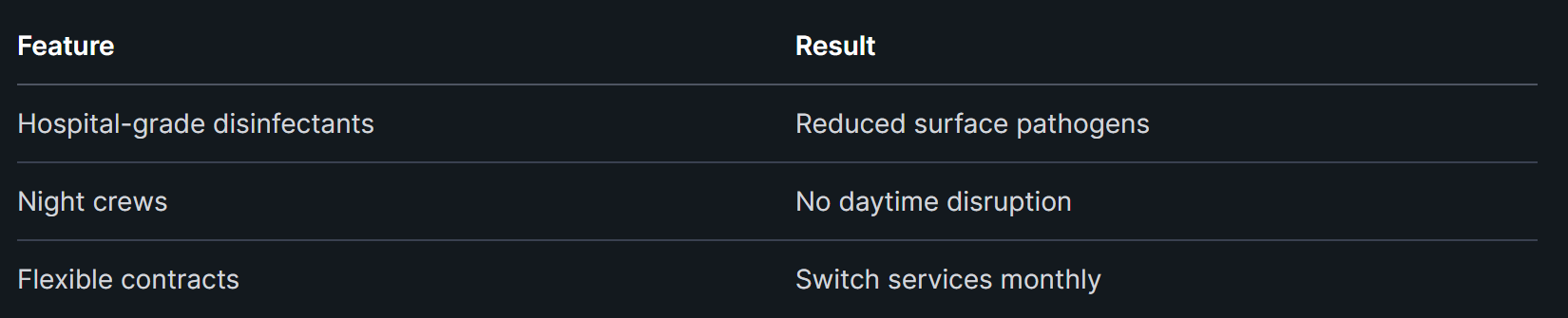
I include 3–4 bullet points showing measurable benefits: frequency, response time, insured/licensed status, and a recent local client or metric (e.g., “cut supply costs 18% for a 10k sq ft site”).
A short testimonial or client name adds credibility.
I finish with a single, concrete ask and clear contact details (phone, booking link, or 15‑minute calendar slot).
Keep the whole email under 150–200 words to respect time and increase read rates.
Importance of Personalization
I tailor each email to a specific recipient role and facility type—property manager, facility director, or office manager—mentioning a detail like building size, recent review, or visible issue (e.g., lobby stains, high-traffic breakroom).
That precise detail signals I researched them, increasing open and reply likelihood.
I use dynamic fields in my email templates—company name, decision-maker, last service date—so each send feels bespoke without extra drafting time.
When I reference a nearby client or a specific outcome (reduced complaints, faster turnaround), I avoid generic flattery and deliver factual relevance.
Personalization also informs which service angle I emphasize: cost savings for financial stakeholders, compliance and certification for healthcare facilities, or flexible hours for retail locations.
Value Proposition in Cleaning Service Emails
I state one clear value proposition in the opening and support it with concrete evidence.
For example: “Nightly janitorial that reduces sick-day claims by targeting high-touch surfaces with hospital-grade disinfectants.” That ties service to a business outcome.
I quantify benefits where possible—time saved, cost avoided, uptime improved—and highlight certifications (OSHA, EPA-approved products, bonded and insured).
I list two differentiators in bold to stand out: faster response times and proprietary quality checks or a client portal for issue tracking.
Short case notes (client name, problem solved, timeline) reinforce the claim without overwhelming the reader.
Call to Action Strategies
I use a single, simple CTA to avoid choice paralysis: schedule a 15-minute walk-through, reply “Yes” to get a custom quote, or click a booking link to select an inspection slot.
Each CTA maps to the next step in our sales process and reduces back-and-forth.
I present the CTA visually—bold or as a short line on its own—and add a low-friction alternative, such as “reply with best time” if they prefer email.
Where appropriate, I add urgency tied to availability (e.g., “slots this month are limited”) but avoid pressure language.
Finally, I include direct contact info beneath the CTA so the recipient can call or text immediately.
Crafting Compelling Subject Lines for Cleaning Service Outreach
I focus on subject lines that increase open rates and push readers toward the message inside.
Short, specific language and a clear value promise drive both opens and click-through rates.
Best Practices for Email Subject Lines
I keep subject lines between 30–50 characters when possible to avoid truncation on mobile and desktop inboxes.
Lead with the benefit: mention cost savings, faster turnaround, or health/safety improvements (for example: “Lower janitorial costs for 3 buildings”).
Avoid spammy words like “Free,” ALL CAPS, and excessive punctuation; these harm deliverability and open rates.
Test 2–3 variants per campaign using A/B tests to measure which phrasing lifts open rates.
Track subject-line performance alongside click-through rates to know whether opens convert to action.
Use clear verbs and numbers to set expectations; recipients should instantly know why they should open the email.
Using Personalization in Subject Lines
I use personalization sparingly and relevantly—company name, facility type, or a recent local event work best.
Examples: “Office manager at GreenTower — weekend cleaning quote” or “Seattle clinic: infection-control cleaning options”.
Personalization increases open rates when it demonstrates research and relevance instead of generic tokens like {FirstName}.
Combine personalization with a tangible benefit to avoid sounding intrusive.
If I can’t personalize for every recipient, I segment lists (by industry, building size, or region) and tailor subject lines for each segment to maintain relevance and improve engagement.
Creating Urgency and Curiosity
I create urgency with specific, time-limited offers or operational windows: “15% off May contracts — ends Friday”.
Pair urgency with a clear reason to act now; vague deadlines often reduce trust and click-through rates.
I use curiosity sparingly and always follow through in the email body; subject lines like “Why your lobby cleaning costs are rising” prompt opens but require factual support inside.
Avoid false scarcity or clickbait phrasing, which damages long-term deliverability and response rates.
Test urgency vs. curiosity over multiple sends to see which approach yields better opens and downstream conversions for your cleaning service outreach.
Personalization Techniques to Boost Response Rates
I prioritize precise research and targeted messaging to increase replies from facility managers and homeowners.
The following tactics focus on data-driven prospecting, clear segmenting, and message tailoring that raise response rates for cold emailing.
Market Research for Targeted Outreach
I start by mapping decision-makers and site details before I write a single email.
Use LinkedIn filters to find facility managers, property managers, or office managers; note company size, location, and any recent facility news.
Combine that with Google Maps or local business directories to confirm building type and foot traffic patterns.
I collect three concrete data points per lead: hiring/expansion signals, recent online reviews mentioning cleanliness, and contract cycle timing (quarterly/annual).
These facts let me open with a specific trigger line instead of a generic introduction.
I also track lead source and engagement in a CRM to improve lead generation over time.
Segmenting Commercial and Residential Prospects
I separate lists into commercial (offices, medical, retail) and residential (HOAs, apartment complexes, single-family) to change both tone and offer.
For commercial clients I emphasize compliance, janitorial staffing, and flexible night shifts; for residential prospects I stress move-in/move-out cleaning, tenant satisfaction, and amenity upkeep.
Use different subject lines and KPIs for each segment.
Commercial subject lines highlight reliability and audits; residential lines highlight convenience and rates.
I typically create two templates per segment: one that aims to book a survey and another that offers a limited-time estimate or trial clean.
Tailoring Content for Client Needs
I open emails with a single sentence that references a verified detail—e.g., "I noticed your downtown office recently expanded into 8th Street."
That specific line improves reply likelihood more than generic flattery.
Then I state a measurable benefit: reduced sick-day reports, lower supply costs, or a 15–30 minute guaranteed turnaround for complaint resolution.
I use brief bullets to list relevant services: daily janitorial, green-clean options, post-construction cleans, and emergency response windows.
I end with a single clear CTA—book a 15-minute site review or request a free proposal—and include social proof: one local client name and a short metric (e.g., "reduced complaints by 40%").
Effective Cold Email Templates for Cleaning Companies
I focus on concise, practical templates that book meetings, explain services, and drive responses.
Each example shows subject lines, one to three short body paragraphs, and a clear call to action you can copy and adapt.
Introduction Email Examples
I start introductions with a specific trigger — a referral, nearby business, or a recent Google review — to show relevance.
Use subject lines like: Quick question about [Business Name] or Nearby office? A cleaning option.
Keep the first sentence one specific observation: a parking lot, lobby traffic, or visible trash.
Follow with one sentence that explains who I am: my company name, years in business, and one credential (insured, bonded, or certified).
Then list 2 tangible benefits in bullet form:
- Faster turnaround on emergency cleans (same-day available)
- Fixed monthly pricing with itemized invoices
End with a single clear CTA: "Are you available for a 10‑minute call Wed or Thu?"
Use a P.S. with a short social proof line: "P.S. We service three buildings on your block — happy to share references."
Service Highlight Templates
I highlight a single service per email so prospects don’t feel overwhelmed.
Use subject lines like: Floor care plan for [Building Name] or Deep-clean option for your reception area.
Open with the pain point: grout discoloration, odor in break rooms, or missed weekend cleans.
Describe the service in two short sentences: what I do and the immediate outcome (e.g., restored grout color, HEPA-filter dust removal).
Close with a micro-CTA: "Can I send a 30‑second video of our floor machine in action?"
Keep pricing cues optional: "Estimates start at $X/month for similar sites."
Special Offer and Promotional Emails
I use time-limited, measurable offers to prompt fast replies.
Subject lines: 20% off first 3 months — [Company Name] or Complimentary first deep clean for new clients.
State the offer in one direct sentence and list exact terms in bullets: duration, eligible locations, exclusions, and booking deadline.
Example bullets:
- Offer: 20% off first 3 monthly invoices
- Valid for offices 2,000–10,000 sq ft
- Expires: 30 days from email date
Include one short testimonial or a quantified result: "Reduced sick-day reports by 12% at a nearby firm."
Finish with a single, urgent CTA: "Reply 'BOOK' to reserve your slot this month." Use bold on the deadline and offer line to draw attention.
Optimizing Cold Email Campaigns for Commercial Cleaning
I focus on measurable changes that improve response rates, reduce bounces, and increase booked walk-throughs.
Below I explain how I test subject lines and copy, protect sender reputation, and interpret opens and conversions to scale campaigns.
A/B Testing and Optimization
I run A/B tests on one variable at a time: subject line, opening sentence, or call-to-action (CTA).
For subject lines I test length, personalization (company name vs. recipient name), and explicit value (e.g., “Reduce janitorial costs 15%”).
I send each variant to a statistically significant sample—typically 10–20% of the list per variant—so results are reliable.
I track these metrics: open rate, reply rate, click-through rate (if links exist), and booked walk-throughs.
I keep a testing log with date, segment, variant, and outcome.
If one variant wins by a clear margin (usually >10% uplift on the primary metric), I roll it into the main sequence and iterate the next variable.
I avoid multi-variable tests unless I use a multivariate testing platform.
That keeps causation clear and prevents wasted resources.
I schedule tests continuously, not one-off, to adapt messaging for seasonal or local demand shifts.
Improving Email Deliverability
I maintain a clean sender reputation by using dedicated sending domains and authenticated mail (SPF, DKIM, DMARC).
I warm new domains gradually: start with low daily volume, increase 10–20% each week, and monitor bounce rates.
I segment lists to separate cold prospects from warm leads and exclude hard bounces and spam complaints immediately.
I also remove role addresses (e.g., info@) and known catch-alls unless I have prior permission.
I keep HTML minimal, include plain-text alternatives, and avoid spammy words and excessive punctuation.
Throttle sends per ISP limits and use a reputable SMTP provider to reduce blacklisting risk.
Analyzing Open and Conversion Rates
I treat opens as an engagement signal, not success.
I look for consistent open-to-reply and open-to-booking ratios per campaign.
If open rates are high but replies are low, I change the email body or CTA; if both are low, I test subject lines and sender name.
I use cohort analysis to compare conversion rates by vertical, company size, and geographic area.
That reveals which segments respond to pricing, which respond to service guarantees, and which need tailored proof points like case studies.
I report conversion metrics weekly and calculate Cost Per Walk-Through (CPW) and Close Rate to decide budget allocation.
Follow-Up Email Strategies for Cleaning Service Leads
I focus follow-ups on timing, concise value, and clear next steps so prospects move from interest to booking.
I use short, varied messages that offer specific benefits like a free consultation and transparent scheduling options.
Timing and Frequency of Follow-Ups
I start with a first follow-up 48–72 hours after the initial cold email to catch prospects while the message is still fresh.
If there’s no reply, I send a second follow-up 4–7 days later offering a specific action: a free consultation or a time slot to schedule a walkthrough.
For longer sequences, I space subsequent touches at 7–10 day intervals and limit the cadence to 4–6 follow-ups total.
I track opens and clicks; if a prospect opens multiple times, I accelerate the next reach-out.
If someone explicitly asks not to be contacted, I remove them immediately to keep outreach respectful and compliant.
Crafting Effective Follow-Up Emails
I keep subject lines direct and benefit-led: “Quick: 20% off first deep clean” or “Free 15‑minute consultation this week?”
First sentence restates context: who I am and which property or service I referenced.
Then I present a clear, single call-to-action—typically one of these: schedule a free consultation, reply with availability, or click to book online.
I use short bullets to list tangible benefits: same-week availability, licensed staff, satisfaction guarantee.
I personalize with one specific detail from the prospect (building type, previous inquiry), which raises reply rates.
I end with an easy scheduling option: two proposed times or a link to book directly.
Nurturing Leads to Conversion
I combine follow-up emails with gentle value touches: a short case study, before/after photos, or a limited-time discount.
I send these as 1–2 sentence add-ons in follow-ups to avoid long emails and preserve attention.
I segment leads by engagement: hot (booked consultation), warm (opened/clicked), cold (no activity).
For hot leads I push immediate booking; for warm leads I offer a free consultation to address objections.
For cold leads I try a final break-up email offering one low-effort option to schedule.
I log each interaction and adjust messaging based on responses to improve future cold email outreach and the cleaning service email template performance.
Offering Customized Cleaning and Service Packages
I explain specific package options, pricing approaches, and credentials so prospects can quickly see value and fit.
I focus on deep-clean capabilities, green products, and how plans adapt to client needs.
Showcasing Deep Cleaning and Eco-Friendly Options
I list deep cleaning tasks clearly so clients understand scope: grout scrubbing, baseboard and vent dusting, carpet shampooing, oven and refrigerator degreasing, and sanitizing high-touch surfaces.
I state frequencies (one‑time, monthly, quarterly) and typical durations (2–6 hours for a 2–3 bedroom home) to set expectations.
I highlight eco-friendly choices by naming approved products or certifications (EPA Safer Choice, Green Seal) and specifying methods like microfiber use, HEPA-filter vacuums, and low-VOC disinfectants.
I offer a short table for quick comparison:
- Service: Deep Cleaning — Tasks: Intensive surface, appliance, and fabric care — Typical time: 3–6 hrs
- Service: Eco-Friendly Clean — Tasks: Same scope using green products — Typical time: +15–30 mins for specialty handling
I invite clients to request a hybrid: deep clean with selective green products for sensitive areas such as nurseries or medical offices.
Presenting Tailored Cleaning Plans
I outline three modular plan structures to choose from: Basic (weekly/biweekly standard clean), Enhanced (adds monthly deep tasks), and Custom (client-selected tasks and schedule).
I describe pricing models: flat-rate per visit for recurring plans, per-hour for one-offs, and bundled discounts for multi‑service contracts.
I explain how I personalize plans by surveying the space, noting pet hair patterns, foot-traffic zones, and allergy concerns.
I provide examples: a 3‑bed home with two pets benefits from weekly basic plus monthly carpet cleaning; a small office may prefer nightly 1.5‑hour cleanings with daily sanitizing of shared equipment.
I include a short checklist I use during estimates: square footage, number of occupants/pets, flooring types, and priority areas.
This ensures quoted packages match actual needs and avoid surprise charges.
Highlighting Certifications and Industry Expertise
I present relevant credentials up front: training certificates, occupational safety courses, and any manufacturer-approved product certifications.
I name specific qualifications where applicable (OSHA‑aligned training, GreenGuard or Green Seal product training) to build trust.
I describe my team's experience with professional cleaning services contracts for residential and commercial clients, including handling sensitive environments like medical offices or childcare centers.
I note compliance behaviors: documented cleaning logs, insured staff, and background checks.
I recommend including certifications in the email outreach: a brief bullet list of credentials and a one‑line link to digital proof or client testimonials.
This practical inclusion increases response rates by reducing perceived risk for decision-makers.
Frequently Asked Questions
I cover the specific components, opening lines, best practices, template sources, a staff-targeted example, and a short pitch you can drop into outreach.
Each answer gives concrete steps and sample phrasing you can use immediately.
What elements should I include in a professional email offering cleaning services?
Include a clear subject line that states the benefit or service, such as "Weekly Office Cleaning to Reduce Sick Days."
Start with a personalized greeting and one brief sentence showing you know the recipient (building name, recent review, or business type).
State your value proposition in 1–2 sentences: what you do, who you serve, and the concrete benefit (time savings, compliance, healthier workplace).
Add one short credibility item: years in business, a relevant certification, or a client testimonial line.
Finish with a single call to action (schedule a 10-minute walk-through, reply with availability) and concise contact details.
How can I effectively introduce my cleaning services to potential clients via email?
Open with a specific observation about the prospect's site or need, for example, "I noticed your clinic has extended hours and high patient traffic."
Follow immediately with the benefit you deliver, such as "I help clinics reduce HAIs with nightly disinfection protocols."
Offer a low-effort next step: propose a 10-minute call or an on-site walk-through at a time you suggest.
Include one credibility line and an easy opt-out: "If this isn't relevant, reply 'not now' and I won't follow up."
What are some best practices for writing a cold email to promote my cleaning services?
Keep emails under 125 words and focus on one clear outcome you want from the recipient, like scheduling a visit.
Personalize at least the first line and the subject to the recipient's industry or facility type.
Use measurable benefits when possible (e.g., "reduce cleaning time by 30%" or "pass health inspections consistently").
Follow up 2–3 times with short, varied messages; stop after the third follow-up unless you receive engagement.
Where can I find free templates for cold emails tailored to cleaning services?
Look for template collections on small-business marketing blogs and emailing platforms that publish industry-specific examples.
Free template generators and marketing tools often let you filter by "commercial cleaning" or "residential cleaning."
Local business forums and cleaning-industry associations sometimes share tested scripts and outreach sequences.
Always customize any free template to include specific client details and one credibility line.
Can you provide an example of an email template that addresses staff about office cleaning?
Subject: Quick note about improving our shared office cleanliness
Hi team,
I want to propose a weekly evening cleaning slot to keep high-touch areas disinfected and reduce desk clutter.
This takes one hour and targets door handles, shared keyboards, and kitchen surfaces.
If you support adding this, reply with preferred evening(s) and I'll coordinate with facilities for a trial week.
Thanks — I appreciate your input.
How do I craft a compelling cleaning services introduction for my business in an email?
Start with one sentence that names your specialty and the main outcome. For example, "I provide overnight janitorial services that ensure offices reopen germ-free."
Follow with a single credibility fact, such as years in service, a major client, or a certification.
Close by proposing a precise next step and a short time commitment, such as a 10-minute phone call or a free 30-minute site assessment.
Keep language concrete and limit claims to what you can document or demonstrate.